WhatsApp us: 6012-6231866
- Email: customerservice@signature.my
WhatsApp us: 6012-6231866
Key takeaways
A CIDB licence in Malaysia is the first thing a renovation business has to deal with, whether you are starting from scratch or adding renovation to an existing portfolio. Before taking on any paid construction or renovation work in Malaysia, a contractor must be registered with the Construction Industry Development Board. Understanding the licence itself, its grades, and the application process is the first real step to operating legally and winning bigger projects.
This guide covers what CIDB is, what the licence is, whether renovation contractors need it, the grades and categories, what to confirm before applying, how to apply, which contract to use, and how to check or renew one.
A desk with registration documents and a laptop showing an online application form.
CIDB, the Construction Industry Development Board (Lembaga Pembangunan Industri Pembinaan Malaysia), is the government body under the Ministry of Works that regulates and develops the construction industry. A CIDB licence is the registration that legally allows a company to carry out construction and renovation work in Malaysia.
CIDB was established under the Construction Industry Development Board Act 1994 (Act 520). Registration is mandatory under Section 25 of that Act, with limited exemptions under Section 40(1). The licence is issued to an SSM-registered company, not to an individual. The registration certificate itself is called the PPK (Perakuan Pendaftaran Kontraktor), and the SPKK (Sijil Perolehan Kerja Kerajaan) is the additional certificate needed to bid for government projects, which requires a valid PPK first. Operating without registration carries a fine of RM10,000 to RM100,000 under Section 29. Under Section 30, the Board can also issue a written notice ordering a contractor to stop work already underway.
For fee schedules, processing times, and the full document list, read: CIDB Contractor Registration.
Yes, renovation and interior fit-out contractors carrying out building works in Malaysia are required to be CIDB registered.
Renovation and fit-out works fall under construction works that require registration. They are not treated as a separate category. Operating without it risks fines and a stop-work order. It also closes off larger and corporate projects, which ask for proof of registration before they will consider a quotation. Requirements change over time, so check the current rules with CIDB before you commit.
| Grade | Maximum tender value | Minimum paid-up capital |
| G1 | Up to RM200,000 | RM5,000 |
| G2 | Up to RM500,000 | RM25,000 |
| G3 | Up to RM1 million | RM50,000 |
| G4 | Up to RM3 million | RM150,000 |
| G5 | Up to RM5 million | RM250,000 |
| G6 | Up to RM10 million | RM500,000 |
| G7 | No limit | RM750,000 |
CIDB registers contractors by category as well as grade. The categories cover building construction, civil engineering, mechanical and electrical, and facility work. Renovation and interior fit-out fall under building construction.
A contractor can hold more than one category, depending on the qualifications of their technical staff. But a contractor cannot carry out work outside the category they hold, and cannot take a project above their grade’s value limit. Both are conditions of registration.
Check which category your work falls under with CIDB before applying.
Most new renovation businesses start at G1, which covers projects up to RM200,000 and carries the lowest capital requirement, then upgrade as they grow.
G1 suits a new or small renovation contractor taking on residential jobs. G2 and G3 open up larger residential and small commercial work as the business grows. Upgrading to a higher grade requires meeting that grade’s capital, technical, and track record criteria. There is no fixed waiting time between upgrades if the criteria are already met.
Before applying, confirm the details that decide your grade and eligibility.

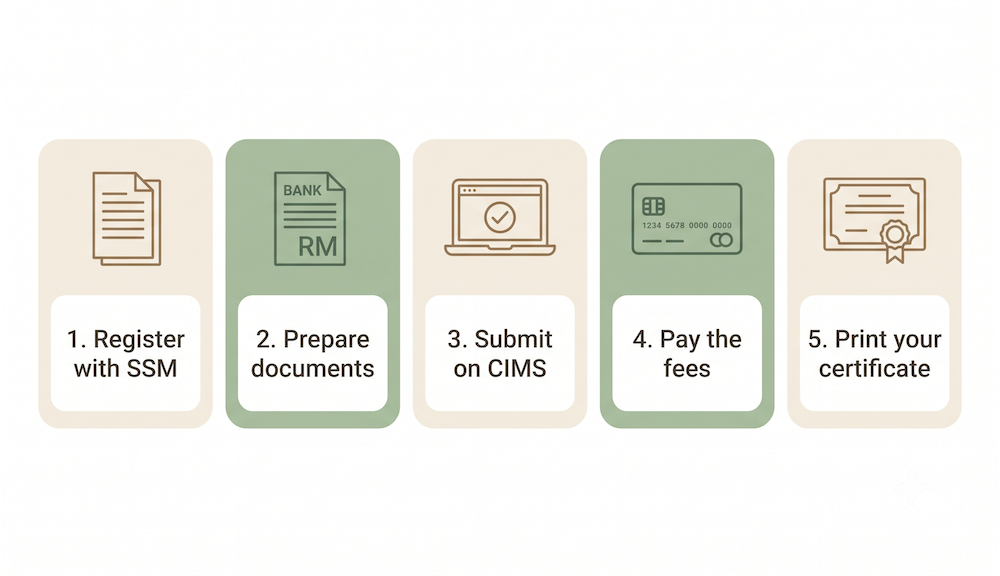
Applying for a CIDB licence, from SSM registration to printing the certificate.
You apply for a CIDB licence online through the CIMS portal, after registering your company with SSM and meeting the paid-up capital and technical requirements for your target grade. Each step below builds on the eligibility checks confirmed above.

An active SSM registered company is the starting requirement before any CIDB application can proceed.
Ensure the required paid-up capital is in the company bank account, and gather the SSM certificate, bank statement or audited accounts, and technical staff qualifications for your target grade.
Register on CIDB’s CIMS portal and submit the contractor registration application along with the supporting documents.
Fees are paid online through CIMS, and the deadlines are enforced automatically. The processing fee is due within seven days of submitting, and the registration fee within fourteen days of the approval letter. Miss either and the application is cancelled without notice, and you start again. Cheques are not accepted and fees are non-refundable.
CIDB processes the application within a set period. Once approved, the PPK certificate can be printed online directly through CIMS.
CIDB’s Contractor Search lets anyone verify a contractor’s registration, and the CIMS portal handles renewal before a certificate expires.
Checking matters on both sides. A homeowner or developer confirms the contractor is legal and graded for the job. A contractor confirms their own certificate has not lapsed, because after expiry they cannot tender for or continue any construction work until it is renewed. Renewal is submitted through CIMS, and the certificate is printed online once approved.
CIDB publishes a free standard contract written for renovation work and small projects, the STCC-RSP 2015, available in English and Bahasa Malaysia.
It is written in plain language rather than legal drafting, and it works alongside drawings, specifications, and a costed list of works to form a complete contract. There is no minimum or maximum project value it applies to. A verbal agreement is valid in law, but a written contract is what settles a dispute over scope or payment. Download the standard terms from CIDB rather than drafting your own.
It breaches the conditions of registration. A contractor cannot take a project above their grade’s value limit, and cannot carry out work outside the category they are registered for. CIDB can suspend or cancel a registration for breaching those conditions, and a suspended contractor cannot tender for new work or continue existing work.
Use CIDB’s Contractor Search to confirm registration status, grade, and validity. Ask for the registration number first, since the certificate carries a QR code that can be scanned to verify it. CIDB has a separate search for Construction Personnel Cards if you want to check the workers as well.
Yes. A contractor cannot tender for or carry out any construction work after the certificate expires and until it is renewed. The registration period and fee are set out in CIDB’s fee schedule, so check the term that applies to your grade rather than assuming a fixed length.
Registration is issued to a business entity registered with SSM, not to an individual, so the business has to be registered before applying. Confirm with CIDB which entity types qualify for your target grade, since capital requirements differ between an enterprise and a Sdn Bhd.
A CIDB licence is a legal requirement, not a formality. G1 is the usual entry point for a new renovation business, building construction is the category that covers fit-out work, and both the grade limit and the category limit are conditions you can lose your registration for breaching.
Register the company first, get the paid-up capital into the bank account rather than committing it on paper, and check current fees with CIDB before you apply.
If you are building a renovation or home improvement business, partnering with an established brand is one route to start with products, systems, and support already in place.
Signature Malaysia runs a dealer programme with in-house trainers, marketing support, and a showroom setup completed within two months, with HQ handling the showroom design and grand opening.
Learn more about becoming a Signature Malaysia dealer.
For a broader look at starting a renovation business in Malaysia, read: A Complete Guide to Starting a Renovation Business in Malaysia.
Limited to 50 slots only!