WhatsApp us: 6012-6231866
- Email: customerservice@signature.my
WhatsApp us: 6012-6231866
Key takeaways
Malaysia has a large stock of ageing terrace houses, condos, and landed homes, and owners renovate rather than move. That is what keeps renovation work coming, separately from whatever the new-build market is doing.
Starting a renovation business is achievable, but it takes more than tools and a first job. Registration, licensing, and planning are what separate a business that lasts from one that folds in the first year.
This guide covers whether it’s worth starting, the step-by-step setup, costs, common mistakes, and whether a dealership is a faster route in.
Floor plan and tools on a table in a partly renovated Malaysian home.
A renovation business can be worth starting in Malaysia because demand is consistent and startup costs are lower than heavy construction, though margins depend on pricing discipline and reliable delivery.
Demand stays steady thanks to ageing homes and ongoing property upgrades across the country. That said, competition is real, and cash flow management matters as much as winning the work in the first place.
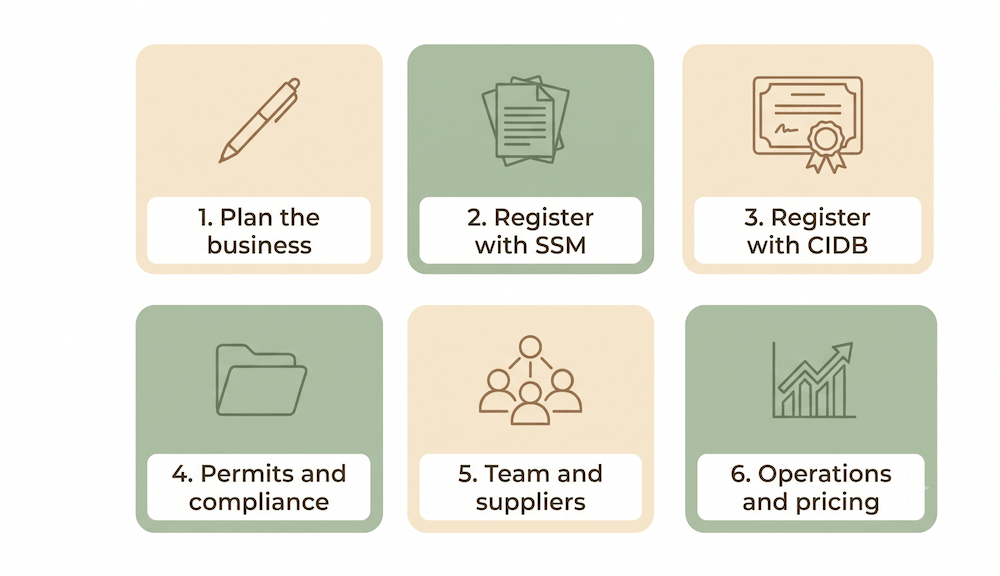
Starting a renovation business in Malaysia, from planning to operations.
Starting is a sequence. Plan first, register correctly, then build the team and systems that let you deliver consistently.

Start by defining your niche, your target customer, and a simple business plan that covers services, pricing, and startup capital.
Pick a niche. Kitchens, full home renovation, office fit-out, or cabinetry-led work, rather than trying to cover everything at once. Identify your target property types and customers early, since this shapes almost every other decision. A renovation business plan needs to cover services, your pricing approach, and capital needs, not just a general idea of the market. Estimate startup capital realistically. A renovation business needs far less than heavy construction does.
Register your business with the Companies Commission of Malaysia (SSM), with most renovation businesses choosing a Sendirian Berhad (Sdn Bhd) for limited liability and credibility.
The choice between a sole proprietorship and an Sdn Bhd matters here. An Sdn Bhd suits contracting work because of the liability protection and the credibility it carries with clients. What you receive is a certificate of incorporation, which becomes the foundation for licensing and opening business bank accounts, and you can register online through the Companies Commission of Malaysia.
A renovation contractor licence from CIDB is mandatory, and most new businesses start at grade G1.
This is not optional. It is required by law under the CIDB Act 1994 (Act 520), and renovation and interior works count as construction works under that Act. There is no exemption for smaller jobs. G1 is the entry grade, and businesses move up as capital and track record grow. Applications go through CIDB’s CIMS portal once you meet the capital and technical requirements.
For the full breakdown of grades, capital, and the application process, read: CIDB Licence Malaysia Guide: A Must-Have for Renovation Contractors.
Beyond SSM and CIDB, a renovation business may need local authority approvals and per-project permits.
A business premises licence from the local council is often required. Renovation permits may apply per project depending on the scope of work. Awareness of Uniform Building By-Laws and safety obligations matters too, along with keeping proper records and insurance in place. Requirements vary by council, so confirm locally before assuming anything is standard nationwide.
A renovation business runs on reliable tradespeople and suppliers, so build these relationships early.
Core roles typically include a project coordinator, a site supervisor, and trusted subcontractors for wet works, carpentry, and electrical. A dependable supplier network for materials and cabinetry matters just as much as the people on site. Consistency across jobs is what builds a reputation, and it comes from the same people doing the work each time.
Compliance applies to the people, not just the company. Every worker on site needs a valid Construction Personnel Card, and supervisors must be accredited by CIDB.
Set up simple systems for quoting, scheduling, and project management so jobs run on time and on budget.
A clear, itemised quotation format prevents disputes before they start. A pricing approach that protects margin matters more than winning every job at the lowest price. Project scheduling and site management keep multiple jobs from colliding. Accounting and cash flow control deserve real attention, since renovation work is project based and payment doesn’t always arrive on a predictable schedule. Simple tools or software to track jobs make all of this easier to sustain as the business grows.
Notebook of figures, calculator, and receipts for a renovation business budget.
The one cost you cannot avoid is CIDB paid-up capital, and at G1 that is RM5,000. Everything else scales with how you choose to start.
G2 sits at RM25,000 and G3 at RM50,000, and that money has to be in the company bank account, not committed on paper. A bank statement is what CIDB checks.
The rest is variable: SSM incorporation and annual compliance, CIDB processing and registration fees, basic tools, a small core team, marketing and a portfolio, and working capital to fund jobs before payment arrives. Working capital is the one most people underestimate, because renovation is paid in stages and materials are paid for first.
For comparison, a general construction company is often quoted a startup range in the hundreds of thousands of ringgit. A renovation business at G1 starts at a fraction of that.
Most mistakes trace back to skipping registration or underestimating cash flow, not a lack of skill.
Yes. Partnering with an established brand gives you products, systems, and support, so you are not building the whole business from scratch.
A partnership or dealership typically provides a recognised brand, a product range, a supply chain already in place, training, marketing support, and a showroom system. That lowers the barrier for a first-time business owner, and suits entrepreneurs entering the home and living space specifically.
Signature Malaysia runs a dealer programme with in-house trainers who have trained more than 100 business partners, and a showroom setup completed within two months, with HQ handling the showroom design and grand opening.
The controlling factor is CIDB, not SSM. Sdn Bhd incorporation is usually quick, but the CIDB application has its own processing period, and the fee deadlines are enforced automatically. The processing fee is due within seven days of submitting, and the registration fee within fourteen days of approval. Miss either and the application is cancelled and you start again.
Yes, CIDB registration is mandatory for renovation contractors under Act 520, with most new businesses starting at grade G1.
It can be, but margin comes from pricing discipline, not volume. The businesses that struggle are usually the ones competing on price and absorbing scope creep without repricing the job.
It’s possible, particularly through a dealer or partnership model that provides training and systems, though direct experience or a strong technical team still helps considerably.
Starting a renovation business in Malaysia comes down to registering correctly with SSM and CIDB, planning your niche and pricing, and building reliable teams and systems. Partnering with an established brand is one way to start with more support already in place.
If you are ready to enter the home and living business, Signature Malaysia runs a dealer programme covering products, in-house training, marketing support, and a showroom setup completed within two months.
Learn more about becoming a Signature Malaysia dealer.
Limited to 50 slots only!