Signature Malaysia

Kitchen Lighting & Cabinet Lighting: Guide & Ideas for Malaysian Homes

Key takeaways

  • Kitchen lighting works in three layers: ambient, task, and accent. A single ceiling fixture provides only ambient lighting.
  • Under-cabinet lighting eliminates the shadows your body casts onto the countertop, something ceiling lights alone cannot achieve.
  • Warm white lighting (2700K–3000K) creates a cosy atmosphere for the dry kitchen, while cool white lighting (4000K–5000K) is better suited to the wet kitchen, where visibility and task performance are more important.
  • Colour temperature determines the mood, while the Colour Rendering Index (CRI) determines colour accuracy. Even the right Kelvin rating cannot compensate for a low CRI, which can make fresh ingredients appear dull or grey.
  • Kitchen lighting should be planned before cabinetry is installed, making every lighting position an important design-stage decision.

Introduction

Most Malaysian kitchens run on one ceiling light. Stand at the counter to chop an onion and your own shoulders throw a shadow onto the board. The light is there. It is just not where the work happens.

In Malaysian homes, lighting is usually treated as an electrical item and left to the contractor after the cabinets are already built. By that point the ceiling is closed and the only remaining option is a downlight in the middle of the room. Kitchen lighting is a set of layers, and the layers are decided long before you reach the fixture aisle. This holds across a condo, terrace house, semi-D, or bungalow.

This guide covers the three layers, the four cabinet lighting placements, colour temperature by zone, ideas by property type, and what to confirm before the work starts.

For everything to settle before a kitchen renovation begins, read: Kitchen Remodelling: Things to Consider Before Renovating Your Kitchen.

What is kitchen lighting? The three layers explained

A dark Malaysian kitchen with downlights, under-cabinet strips, and lit open shelving.A dark Malaysian kitchen with downlights, under-cabinet strips, and lit open shelving.

Kitchen lighting has three layers. Ambient lights the room, task lights the work surfaces, accent adds depth. A kitchen needs all three. Ambient alone leaves dark counters, task alone feels like a workshop, accent alone is useless to cook in.
Ambient lighting

Ambient lighting is the general layer that lets you see the room and move through it safely. Recessed downlights spaced in an even grid do this, reaching the corners and the walkway between counters. A single fixture in the centre of the room lights the floor and leaves the counters in shadow.

Task lighting

Task lighting is directed light aimed at the countertop, the hob, and the sink. It sits in front of your body rather than behind it, so your shoulders stop blocking it. The tone should be neutral to cool, and the fitting should render colour accurately, or raw chicken and fresh fish read grey under it.

Accent lighting

Accent lighting is decorative light that adds depth. It picks out glass-fronted cabinets, an open shelf, or a backsplash with texture worth seeing. It adds no usable light to the countertop, and it earns its place where the kitchen shares a sightline with the living room.

What are the types of kitchen cabinet lighting?

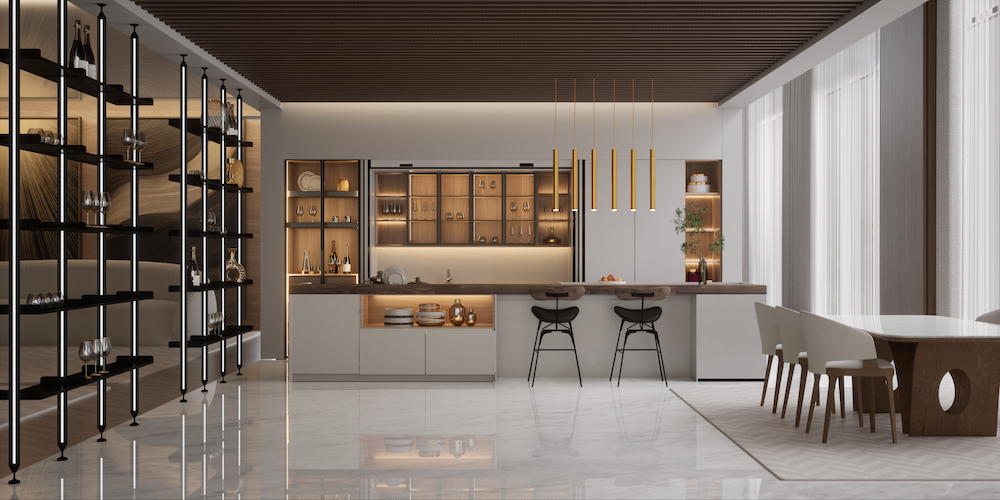
Lit glass display cabinets, under-cabinet strips, and pendant lights in an open-plan dry kitchen.
Kitchen cabinet lighting covers four placements, under-cabinet, in-cabinet, above-cabinet cove, and toe-kick. Most are wired before the cabinets go in. Under-cabinet is the one to get right first, because none of the others changes daily life the way a lit countertop does. Where the strip sits in a recessed channel, that channel is cut at the factory, so the position is fixed on the shop drawing before anything is built.

Under-cabinet lighting

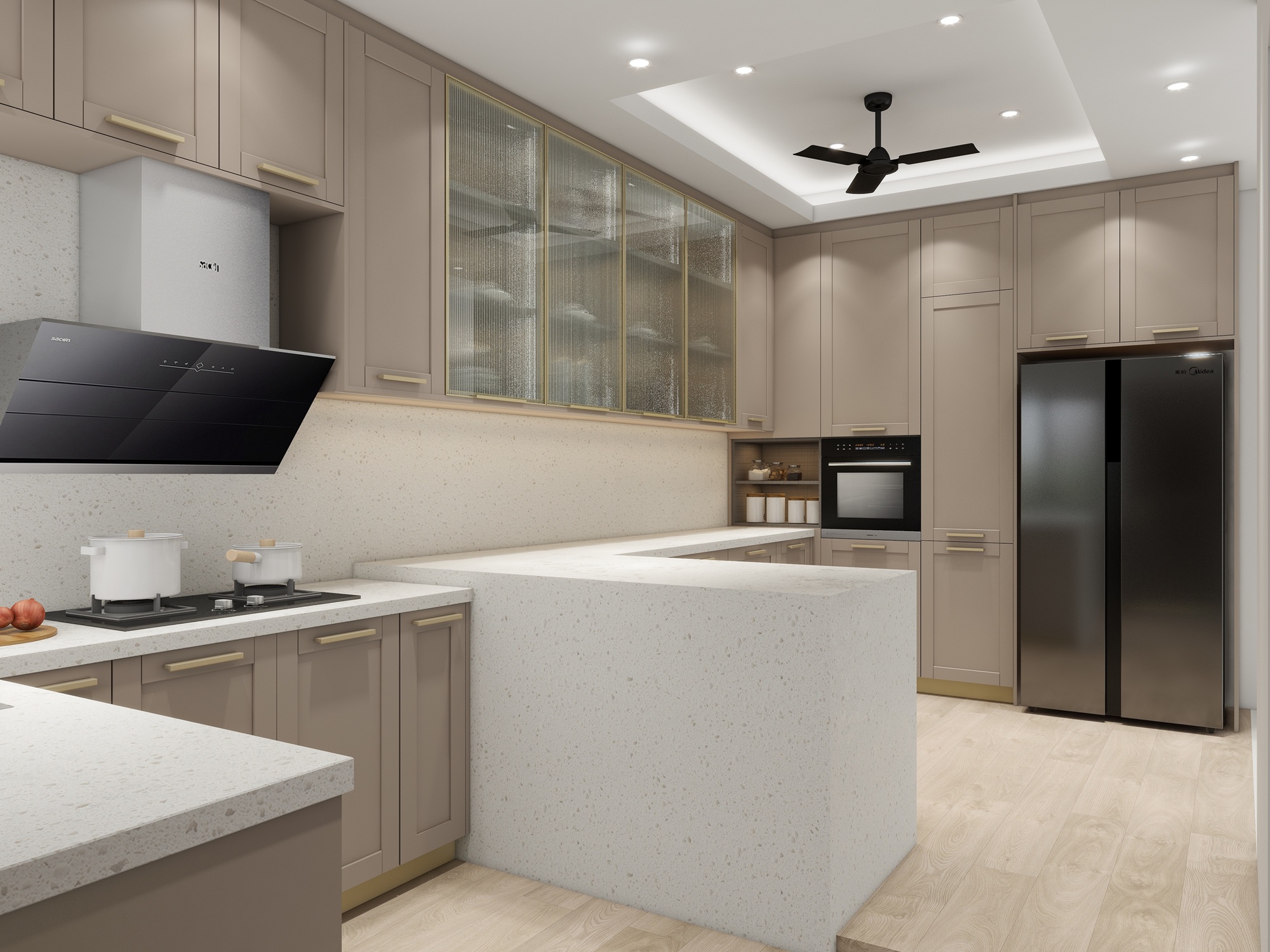
Under-cabinet lighting is a strip fitted beneath the upper cabinets, facing down onto the countertop.

The strip belongs along the front lip of the cabinet base rather than the back. Mounted at the back, under cabinet lighting throws its pool onto the backsplash and leaves the front half of the countertop in shadow. Ask for a frosted cover over the strip, because without one the individual diodes reflect as a dotted line across a gloss countertop.

In-cabinet and glass-display lighting

In-cabinet lighting sits inside a cabinet, usually behind glass doors. It turns crockery and glassware into a lit display once the ambient layer is dimmed. Skip it in the wet kitchen, where grease films the inside of the glass.

Glass tint changes the result. Behind clear glass, a 3000K strip reads as it is, warm. Behind bronze or tea-toned glass the same strip reads amber. Behind grey-tinted glass it reads cooler and flatter. Check the door tint before choosing the strip.

Above-cabinet cove lighting

Cove lighting is a strip laid on top of tall cabinets, washing light upward across the ceiling. The gap between the cabinet top and the ceiling is what makes it work, because the light needs room to spread before it hits the surface. Where that gap is tight, the strip reads as a bright line rather than a soft wash, so ask to see one switched on before you commit to it. The same gap collects dust.

Cove lighting suits a condo, where a lifted ceiling is worth more than it is in a bungalow. It contributes no usable light to the countertop.

Toe-kick lighting

Toe-kick lighting is a low strip set into the recess at the cabinet base, so the cabinets appear to float at night. Add a motion sensor and the strip comes on by itself when you get up for a glass of water.

Ask your contractor for a splash-rated IP44 fitting, because the strip sits at floor level and a Malaysian kitchen floor gets mopped and sometimes hosed down.

For dark cabinet finishes and glass-front lighting ideas, see: 14 Creative Ways to Style and Decorate Your Dark Kitchen.

Warm or cool white: Which suits each kitchen zone?

A cool white Malaysian wet kitchen beside a warm white open-plan dry kitchen.

Colour temperature is measured in Kelvin. Lower numbers look yellower, higher numbers look bluer. The IP number is how much water a fitting can take.

Zone Colour temperature Why Fitting note
Dry kitchen 2700K to 3000K warm Atmosphere in an open-plan space IP20 acceptable
Wet kitchen 4000K to 5000K neutral to cool Shows grease and residue clearly during heavy cooking IP44 or higher
Task zone 3500K to 4000K neutral Shows food close to its true colour Sealed cover, easy to wipe
Accent and display 2700K to 3000K warm Soft evening glow behind glass Low output, dimmable

Kelvin decides how the light looks. A separate figure, the colour rendering index (CRI), decides whether colours look true under it. Ask for CRI 80 or above, and CRI 90 over the prep counter. Below that, raw fish and fresh vegetables read grey.

A Malaysian wet kitchen takes wok heat, steam, oil, turmeric, and year-round humidity. It needs light that shows what is in the pan, and a fitting rated to survive it. The dry kitchen is a room people sit and talk in, so light it like a living room.

For more on how each zone works, read: 7 Wet Kitchen Design Ideas for a Stylish & Functional Home, and 12 Dry Kitchen Design Concepts for a Modern and Stylish Home.

Kitchen lighting ideas by property type

Kitchen island with pendant lights and under-cabinet strips.

The right scheme depends on ceiling height and how the kitchen meets the living space.

  • Condo: Even downlight spacing, and cove lighting above tall cabinets. Under-cabinet lighting is not optional here, because the wall cabinet sits close over the counter and blocks the ceiling light.
  • Terrace house and semi-D: Separate switching for the wet and dry kitchens, so the wet kitchen can stay dark while the dry kitchen is in use. Where there is an island, put the pendants on their own switch. They light the island surface when you are prepping, and set the mood when you are not.
  • Bungalow and open plan: Layered accent lighting, so the dry kitchen reads as part of the living space.

For a compact condo kitchen, read: Stylish Condo Kitchen Design Malaysia for Small Spaces.

What to confirm before your renovation begins

By the time the kitchen looks finished, every lighting decision is already locked. Settle these at the design stage.

  • Map the three layers first: Decide where each sits before a wire is pulled.
  • Check the strips against the cabinets: Under-cabinet and cove positions are fixed once the cabinet is made.
  • Switch each layer separately: Cooking light and evening light should never share a switch.
  • Match the dimmer to the strip: An incompatible dimmer makes an LED strip flicker. Ask for the kitchen lights, the transformer, and the dimmer to be quoted as one matched set.
  • Keep one colour temperature per zone: Warm downlights, cool strips, and a neutral pendant in the same sight line look accidental.
  • Use a licensed wireman: Fixed electrical installation is regulated through Suruhanjaya Tenaga.

For the wider renovation picture, read: Kitchen Renovation & Design Ideas.

Frequently asked questions about kitchen lighting

What are the 3 types of kitchen lighting?

Ambient, task, and accent. Ambient lights the room, task lights the countertop where you work, accent lights the finishes. A single ceiling fixture delivers only ambient.

Usually, yes. Renovation works in a strata property are governed by the Strata Management Act 2013 and the by-laws your JMB or MC adopts, and most require written approval before work begins. Rewiring normally falls within that scope. Check the by-laws before the contractor starts, because a stop-work order lands with the walls already open.

It is possible, but it rarely looks the same. Strips added later usually sit on the surface, with the wire running in a visible casing, because the hidden route had to be planned before the cabinets went in.

Yes, but a different fitting. Under-cabinet light matters most where you chop and cook, which in Malaysian homes is often the wet kitchen. Use a splash-rated fitting with a sealed cover. Skip in-cabinet and cove lighting, since neither lasts well in grease and steam.

Conclusion

A kitchen needs three layers of light. Ambient gives you the room, task gives you the countertop, accent gives you the evening. Because the wiring runs before the cabinets, all of it is decided on a drawing, long before the showroom.

Signature Malaysia works from a 3D design proposal built off your floor plan, and renovation only begins once you confirm it. Speak to the team before finalising your kitchen, or explore Signature’s kitchen range.

Our Flagship Store is relocating. Temporarily closed in August 2026, reopening September 2026 at