Signature Malaysia

Certificate of Completion and Compliance (CCC): What Home Owners Need To Know For Renovations

Key takeaways

  • Most renovation works do not require a new CCC, with the exception of extensions and permanent structural additions that increase the built-up area.
  • The CCC is issued by the Principal Submitting Person (PSP), a registered professional appointed by the homeowner, not by the local authority.
  • A renovation permit is the approval to start work; a CCC is the confirmation that the completed works meet all legal and safety requirements.
  • Selling a property with an unapproved extension affects financing, valuation, and legal recognition at resale, and the buyer inherits the legal exposure.
  • Confirm whether your planned renovation scope triggers a CCC requirement before work begins, not after.

Introduction

Most homeowners encounter the CCC at property handover and assume it only applies to new buildings. For most renovation works, that assumption is correct. Internal renovations, flooring replacements, repainting, and built-in cabinetry do not require a new CCC.

The exception is any extension or permanent structural addition that increases the built-up area of the building. Without a CCC for these works, the addition carries no legal recognition as a completed building under Act 133, not at resale, not at the bank, and not with the local authority.

This article covers what the CCC is, when a renovation triggers one, how it differs from a renovation permit, who the Principal Submitting Person is, what happens at resale without one, and what to confirm before starting major works.

What is the Certificate of Completion and Compliance (CCC)?

House keys and property documents handed over at a Malaysian property handoverKeys and documents at a property handover.

The CCC is the official document confirming a building or addition is safe, properly constructed, and legally approved for occupation.
What does the CCC confirm?

  • The CCC confirms construction matches the approved building plans and meets Malaysian building law requirements, including the Street, Drainage and Building Act 1974 (Act 133) and the Uniform Building By-Laws 1984 (UBBL).
  • It replaced the Certificate of Fitness for Occupation (CFO) in April 2007. Properties issued a CFO before that date retain their legal status.

Who issues the CCC in Malaysia?

  • The CCC is issued by the Principal Submitting Person (PSP), a registered architect, engineer, or building draughtsman appointed by the homeowner, not by the local authority. Their professional registration under Lembaga Arkitek Malaysia (LAM) or the Board of Engineers Malaysia (BEM) is what gives the CCC its weight. Check which body applies to the professional you engage before work begins.
  • The local authority does not issue the CCC. It monitors compliance and can take enforcement action under Act 133 if a CCC is not obtained for works that require one.

When does a renovation or home extension require a CCC?

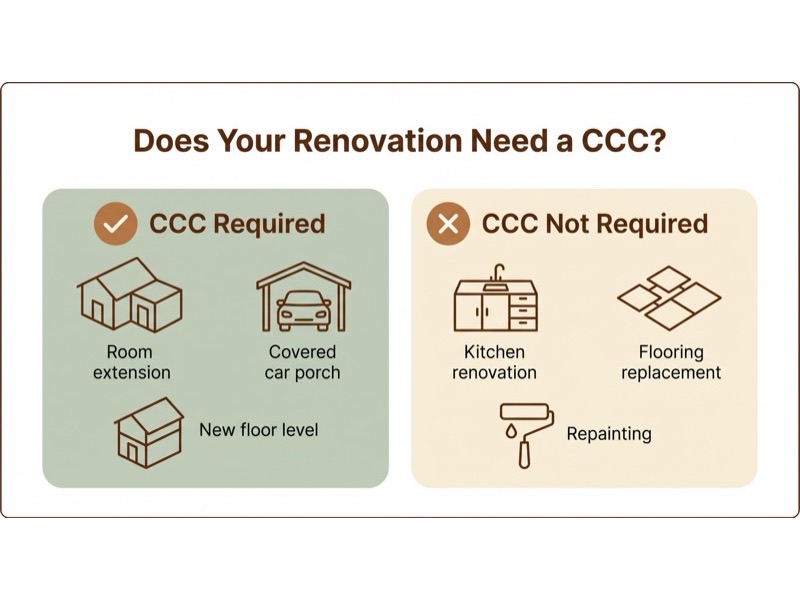
Infographic showing renovation works that require a CCC, such as room extensions, and works that do not, such as repaintingInfographic showing which renovation works require a CCC and which do not.

Not all renovation works require a CCC, but any addition that permanently increases the built-up area or alters the permanent structure does.

  • Extensions that add new covered built-up area: a room addition, a covered car porch, an enclosed balcony, or any new permanent structure that becomes part of the building.
  • Structural alterations that change the approved building footprint or add a new floor level.
  • New permanent structures added to the land within the property boundary, such as a detached utility room or store.
  • Works requiring a new building plan submission and council approval. If the local authority requires a new approved plan, a CCC will be required on completion.

For landed home renovation guidance, read: Guide to Landed Home Renovation in Malaysia: Strata vs. Individual Title.

When is a CCC not required for renovation works?

  • Internal works that do not alter the permanent structure or built-up area: kitchen and bathroom renovations, flooring replacement, repainting, and built-in cabinetry. These typically require only a renovation permit, not a new building plan submission.
  • Non-structural internal partitioning that does not change the approved building layout on record.

For the full permit trigger breakdown, read: Guide For Home Owners & Contractors: Home Renovation Permits & Paperwork In Malaysia.

How does the CCC differ from a renovation permit?

A renovation permit is the approval to carry out works. The CCC is the confirmation that the completed works meet all legal and safety requirements.

CriteriaRenovation permitCCC
Issued byLocal authority or building managementPSP (registered architect, engineer, or draughtsman)
When issuedBefore works beginAfter works are completed
What it confirmsApproval to carry out the proposed worksCompleted structure meets approved plans and legal requirements
When both neededScope involves an extension or permanent structural additionPermit to start, CCC on completion
When only permit neededMinor internal works, no increase in built-up areaCCC not required; confirm with a registered PSP

If both are required for the scope of works, the permit is obtained before works begin and the CCC on completion. Confirm with your local authority which applies to your planned scope.

Who is the Principal Submitting Person (PSP) for a home extension?

Contractor and homeowner reviewing building plans at a Malaysian home extension siteContractor and homeowner reviewing plans at a home extension site.

For a home extension, the homeowner appoints the PSP to submit the building plans and take responsibility for the completed works.

What is the PSP responsible for on a renovation project?

  • Preparing and submitting the building plans to the local authority for approval, then issuing the CCC upon satisfactory completion of all required inspections.
  • Supervising construction to ensure works comply with the approved plans at every stage.
  • Handling all required inspections at each stage. The PSP coordinates with the relevant technical agencies so the homeowner does not have to.
  • The PSP is professionally accountable for the CCC they issue. If the completed works are found non-compliant, they answer to LAM or BEM. The homeowner remains responsible for any unapproved works on the property under Act 133.

What happens if you sell a property with an unapproved extension?

An unapproved extension without a CCC creates legal, financial, and practical complications at resale that are harder to resolve than obtaining the CCC before selling.

  • A bank may decline to finance the buyer’s purchase or reduce the loan if the property carries a structure without a valid CCC. Check with your bank before proceeding.
  • A valuer may exclude the unapproved addition from the official built-up area, reducing the assessed value. Valuation practice varies. Confirm with a registered valuer.
  • Enforcement action under Act 133 applies to the current registered owner regardless of when the unapproved works were carried out. A buyer who takes possession of a property with an unapproved extension inherits that exposure.
  • During conveyancing, a solicitor or valuer may flag that what was actually built does not match the approved plans on record. This can delay or abort a sale.

What should you confirm with your contractor before starting a major renovation?

Before committing to any extension or permanent structural addition, confirm which approvals apply and who is responsible for each one.

  • Confirm whether the scope requires a building plan submission to the local authority, or only a renovation permit, and whether you need to appoint a PSP independently. The PSP must be in place before plans are submitted.
  • Confirm the PSP is registered with the correct body: LAM for architectural work and standard extensions, BEM for structural calculations.
  • Confirm the PSP’s responsibilities in writing: which inspections they will attend and when the CCC will be applied for once works are complete.
  • Signature Malaysia‘s Reno Works coordinates the renovation including liaison with building management, working within the approval requirements for your property type and scope.

For contractor hiring guidance, read: Complete Guide to Hiring a House Renovation Contractor.

Frequently asked questions about the CCC and renovation

Does repainting or retiling need a CCC?

No. These do not alter the permanent structure or increase the built-up area. A renovation permit or management approval may still apply depending on your property type and scope.

No. Occupying a building or extension without a valid CCC is illegal under Act 133. Section 70(27) of Act 133 lists this as an offence carrying a fine not exceeding RM250,000 or imprisonment not exceeding 10 years or both, and it applies to anyone who occupies or permits occupation without a CCC. Confirm the legal position with a solicitor before occupying any completed works.

The homeowner is responsible for the PSP’s professional fees and the inspection fees at each stage. Confirm the full cost with your appointed PSP before committing to the extension scope.

Check your title documents or original handover paperwork from the developer. If you are unsure whether a past extension has a valid CCC, a registered PSP or solicitor can confirm before you sell or refinance.

Conclusion

The CCC is not just a document for new property buyers. Any home extension or permanent structural addition requires one, and without it the addition has no legal recognition as a completed building under Act 133. Confirm whether your planned renovation scope triggers a CCC requirement before work begins, not after.

Signature Malaysia‘s design consultants work within your property’s approval requirements from the design stage, whatever the scope. Signature Reno Works liaises with building management and coordinates the renovation from start to handover. Speak to the team before finalising your renovation plans.