Signature Malaysia

Guide to Condo Renovation Rules in Malaysia

Key takeaways

  • A condo renovation carries an approval layer a landed property doesn’t have. Your JMB or MC must sign off before work begins under the Strata Management Act 2013.
  • Structural walls, columns, and the outer walls of the building are off-limits. Non-structural partitions can usually come down, but a professional still needs to confirm it. It is not a guaranteed yes.
  • Waterproofing isn’t optional once a bathroom is stripped to the slab. Skip it and the dispute lands with the unit below, not your own.
  • Rewiring is planned at the design stage, before carpentry and tiling close the walls behind it.
  • Signature Malaysia’s design consultants plan cabinetry and layout around what a condo renovation can and cannot touch, working within JMB or MC approval from the start.

Introduction

A condo renovation carries a layer of approval a landed property simply doesn’t face. Before a single wall comes down, your JMB or MC has to sign off, and that approval isn’t a formality you can skip because the works look minor to you.

The rules exist because a condo shares walls, floors, plumbing, and a ceiling with the units around it. What one owner does to their unit can show up as a crack, a leak, or a noise complaint two floors away. That’s the whole reason the approval layer exists, and it’s why “it’s my unit” isn’t the same thing as “it’s only my business.”

This guide covers what approval your JMB or MC requires, what you can and can’t change structurally, the plumbing constraints specific to condos, why waterproofing matters as much as it does, what to plan for electrical rewiring, how long the process realistically takes, and the mistakes that turn a straightforward renovation into a dispute.

What approval does a condo renovation need from your JMB or MC?

Every condo in Malaysia is governed by a Joint Management Body (JMB) or Management Corporation (MC). This comes from a law called the Strata Management Act 2013. Whichever one runs your building, renovation approval goes through them before work starts.

  • Working hours and noise: Most buildings restrict hacking and drilling to set hours, and ban it outright on Sundays and public holidays. Ask for the House Rules before you plan anything.
  • Lift and loading access: Materials move through a designated service lift and loading zone, not the main lobby. Confirm this before your contractor’s first delivery arrives.
  • What the application needs: A floor plan, a scope of works, and your contractor’s details, usually submitted together for review.
  • Timing: Approval takes time to process. Build it into your renovation schedule rather than assuming it happens the week you apply.

Skip this step and the risk isn’t hypothetical. A stop-work order lands mid-project, with the walls already open and the contractor already paid.

Signature Malaysia‘s Reno Works liaises with building management on your behalf to secure this approval.

For how JMB/MC approval works specifically for a bedroom renovation, read Things to Consider Before Bedroom Renovations for Different Types of Properties.

What can and can't you change in a condo renovation?

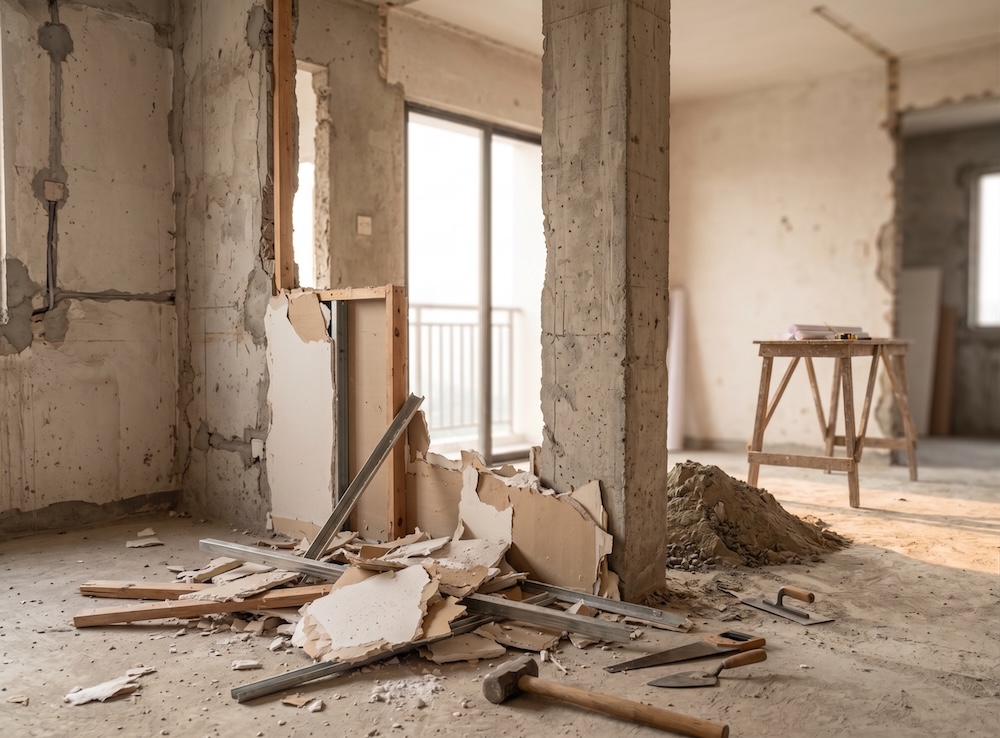
A concrete structural column beside demolished partition wall debris in a condo unit under renovation.

Structural walls, columns, and the outer walls of the building are off-limits. Non-structural partitions can generally come down with approval.
  • Structural elements: Load-bearing walls, columns, beams, and the outer walls of the building hold the structure up and are shared property in effect, even inside your own unit. They stay.
  • Building safety standards: Residential building safety in Malaysia falls under the Uniform Building By-Laws 1984, administered under the Street, Drainage and Building Act 1974. It’s the standard your renovation is measured against, whether you’ve read it or not.
  • Non-structural partitions: These can generally be removed or repositioned, but approval and confirmation are still required before anything comes down.
  • Verify, don’t guess: A wall that looks non-structural to you and one confirmed non-structural by a qualified professional are two different things. Only one of them protects you if something moves.

What are the plumbing constraints in a condo renovation?

Condo units share a vertical plumbing stack with every unit above and below, and that shapes what’s realistic to move.

  • The shared stack: Your bathroom and kitchen plumbing tie into a riser running through the whole building, not just your floor.
  • Relocating wet areas: Technically possible, but it can raise floor levels or lower ceiling height to accommodate the new pipe run.
  • The easier path: Working with your existing wet-area locations is more straightforward than moving them, and it’s the difference between a renovation and a small construction project.

Why does bathroom waterproofing matter so much in a condo renovation?

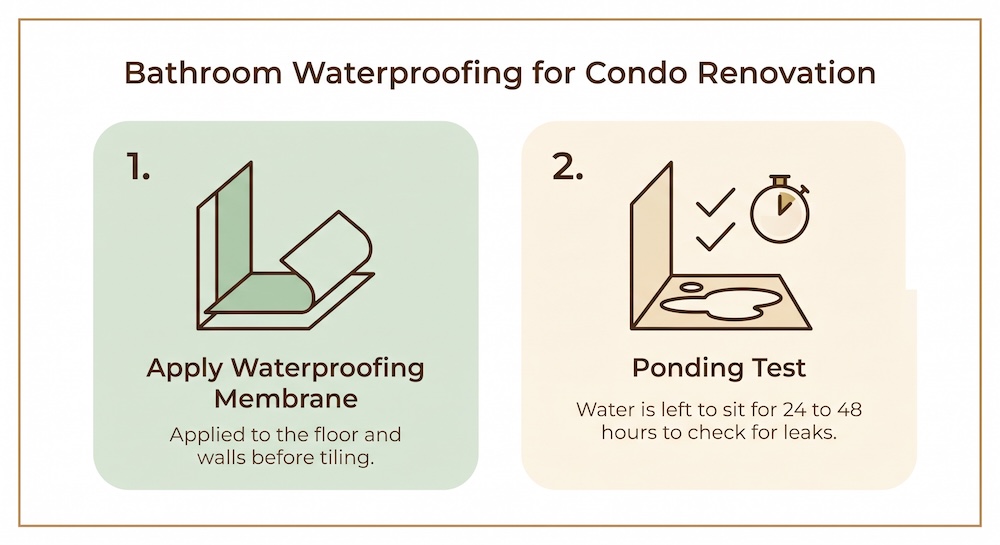
Bathroom waterproofing involves applying the membrane, then running a ponding test.

Seepage into the unit below is the single most common dispute between condo neighbours in Malaysia, and waterproofing is what prevents it.

  • When it’s required: Any time a bathroom is stripped down to the slab, the membrane has to go back in. This is standard trade practice, not a single numbered by-law, so it won’t enforce itself. Specify it explicitly in your scope of works rather than assuming your contractor will include it.
  • The ponding test: Before tiling goes down, the membrane is flooded and left to sit, checking it actually holds water rather than just looking finished. Skip this step and you won’t know there’s a problem until it’s someone else’s ceiling.

For the tile-selection side of a bathroom renovation, read: Bathroom Tiles: How to Choose Hygienic, Slip-Resistant Tiles for Malaysian Homes.
What should you plan for electrical rewiring in a condo renovation?

Older condo units are often wired for far less than a modern household actually draws, and rewiring gets planned before carpentry closes the walls around it, not after.

  • Assess before you plan the layout: An outdated distribution board wasn’t built for today’s appliances, and finding that out mid-renovation means opening walls you’d already finished.
  • Plan power points at the design stage: Adding a point after cabinetry and tiling are in means chasing a channel through a finished wall.
  • It falls under approval too: Rewiring typically sits inside the scope your JMB or MC needs to sign off on, not a side task you can quietly add later.


How long does a condo renovation take?

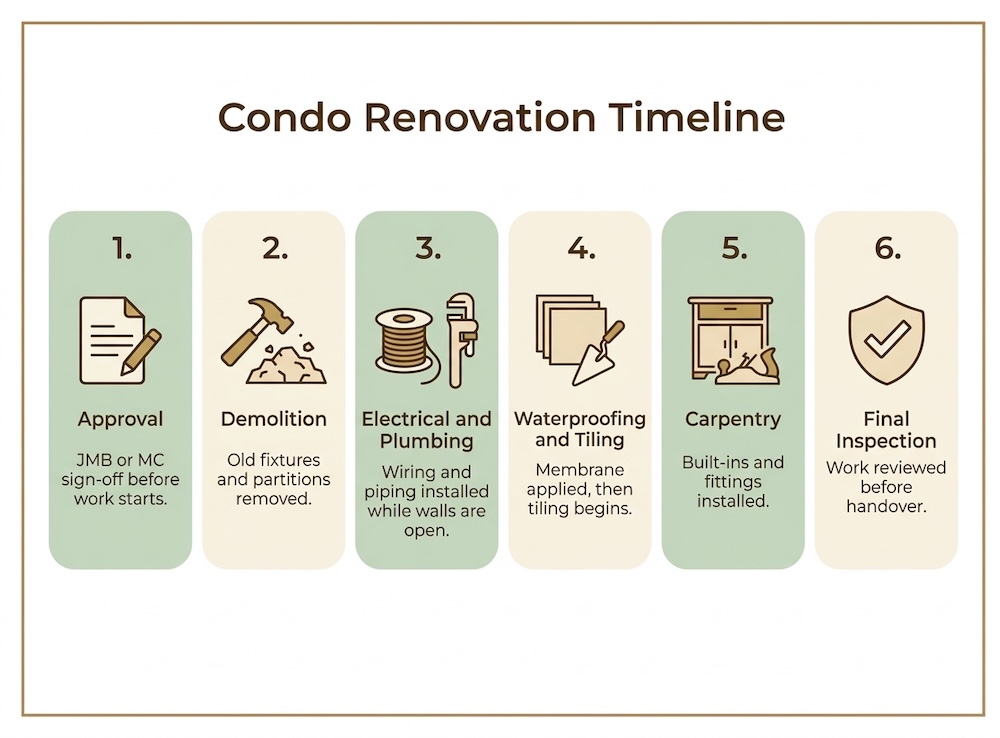
The six stages of a condo renovation, from approval through to final inspection.

A condo renovation moves through a set sequence: approval, demolition, electrical and plumbing rough-in, waterproofing and tiling, carpentry, and final inspection. Each stage depends on the one before it, so a delay early on moves everything after it. 

Approval is usually the longest wait before any physical work starts. Once work is underway, waterproofing, tiling, and carpentry tend to take the longest, since all three need time and precision to get right.

What are the common condo renovation mistakes to avoid?

Most condo renovation problems trace back to a decision made too fast, or a step skipped to save time.

  • Skipping management approval: The most common cause of a stop-work order, and the easiest one to avoid.
  • Hacking a wall without professional confirmation it’s non-structural: A guess here isn’t a shortcut, it’s a liability.
  • Choosing on lowest quote alone: A gap in price is usually a gap in scope.
  • Treating waterproofing as optional: It only feels optional until the unit below starts complaining.
  • Making material or colour decisions on the fly: Once work has started, every change costs more than it would have on paper.

FAQs about condo renovation

Does a condo renovation need approval for minor works like repainting?

Usually not. Most buildings exempt cosmetic work like painting or furniture placement, but the House Rules still decide this per building, so confirm rather than assume.

You risk a stop-work order, fines, and forfeiture of your renovation deposit, on top of having to undo whatever’s already been done.

There’s a specific tribunal for this, the Tribunal Pengurusan Strata (TPS). It sits under KPKT, the housing ministry, and it’s separate from the general consumer tribunal used for contractor disputes.

It’s possible, but check the plumbing implications first. Combining zones can mean rerouting the wet kitchen’s drainage into a layout it wasn’t designed for.

It depends on the landed property’s title. Individually-titled landed homes skip the JMB or MC approval layer condos carry, but strata-titled landed properties still need it. 

For the full breakdown of individual vs. strata title, read: Guide to Landed Home Renovation in Malaysia: Strata vs. Individual Title.

Conclusion

Starting a renovation business in Malaysia comes down to registering correctly with SSM and CIDB, planning your niche and pricing, and building reliable teams and systems. Partnering with an established brand is one way to start with more support already in place.

If you are ready to enter the home and living business, Signature Malaysia runs a dealer programme covering products, in-house training, marketing support, and a showroom setup completed within two months.

Learn more about becoming a Signature Malaysia dealer.

Our New Flagship Store is opening in September 2026. Stay tuned.