Signature Malaysia

Power Tracks vs Power Sockets: The Differences, Advantages & Considerations

Key takeaways

  • A power track is a permanent wall-mounted electrical rail with modular adapters, not an extension cord.
  • Power tracks suit zones where appliance positions change. Wall sockets suit fixed positions and high-draw appliances.
  • The kitchen countertop is the most common power track zone in Malaysian homes.
  • A power track position must be confirmed before cabinet installation begins. It cannot be moved after.
  • Power planning should be integrated into the full renovation specification, confirmed before cabinets and wall finishes are completed.
  • Signature Malaysia integrates power planning into full kitchen and study room renovation specifications as standard.

Introduction

A power track is a permanent wall-mounted electrical rail that replaces fixed socket boxes in zones where appliances and devices change position over time. Unlike a standard wall socket, it allows adapters to be repositioned along the rail at any point after installation without rewiring.

In Malaysian homes, electrical point placement is typically decided after cabinets and flooring are confirmed. By that stage, adding sockets requires hacking finished walls. Power tracks planned at the renovation stage avoid this problem entirely.

This article covers what a power track is, how it compares to a standard wall socket and extension cord, its advantages and limitations, which zones in a Malaysian home benefit most, and what to confirm with a licensed electrician before specifying.

What is a power track?

Power track rail with round modular adapters mounted under a kitchen cabinet.

A power track is a wall-mounted electrical strip with a continuous conductive rail. Modular socket adapters slot in at any position and draw power from the rail. The track is wired into the home’s electrical circuit during renovation. Adapters are added, removed, or repositioned without rewiring. Available as a slim rail flush to the wall or under an overhead cabinet, in white, black, and brushed metal finishes. A power track is not an extension cord or surge protector strip. It is a permanent fixed installation, not a portable device.

Power track vs extension cord: What is the difference?

An extension cord is portable. A power track is permanent. That distinction affects safety, appearance, and long-term suitability.

Factor Power track Extension cord
Installation Permanent, wired into wall circuit Portable, plugs into existing socket
Flexibility Adapters repositioned at any time Fixed by cable length
Appearance Flush-mounted, no trailing cables Visible cables on floor or counter
Safety Licensed electrician, part of home circuit Overloading risk, tripping hazard, fire risk long-term
Capacity Rated to upstream circuit breaker Limited by its own rating, often overloaded
Best use Permanent renovation installation Temporary or portable use only

Extension cords are a temporary solution. A power track is a permanent electrical upgrade planned at the renovation stage.

How do power tracks and power sockets compare?

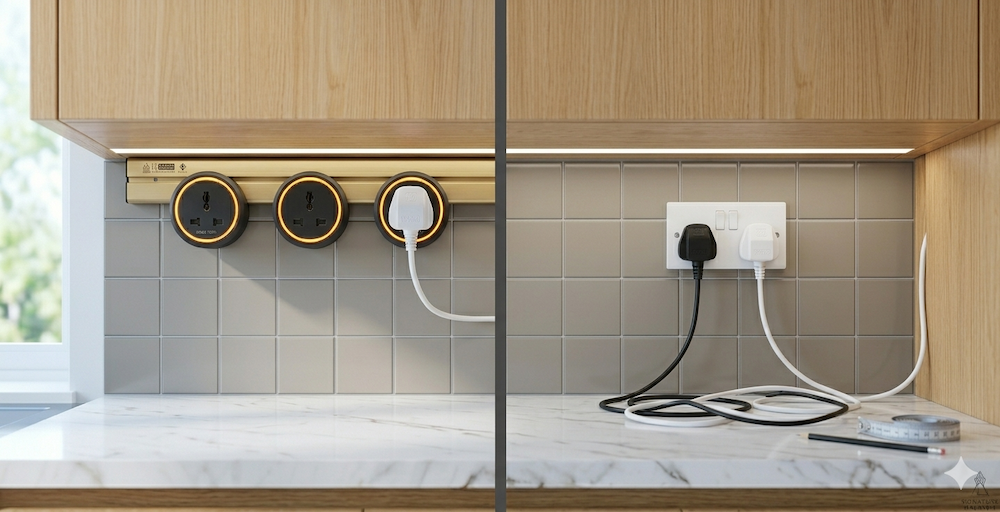
Power track with modular adapters compared to a standard wall socket with trailing cables.

Power tracks and standard wall sockets serve different purposes. Knowing where each performs better is the basis for a good renovation electrical plan.

Factor Power track Standard wall socket
Flexibility Adapters repositioned without rewiring Fixed position, cannot be moved without hacking
Number of points Multiple adapters, expandable Fixed outlets per installed unit
Aesthetics Single slim rail, no multiple socket boxes Multiple socket boxes at different heights
Installation Single wiring run, adapters add on Each additional point requires additional wiring
Cost Higher upfront Lower per-unit, but each addition needs rewiring
High-load appliances Not suitable (oven, water heater, air conditioning) Dedicated circuits required regardless
Maintenance Adapter replacement if one fails Fault requires a licensed electrician

Power tracks and wall sockets are not mutually exclusive. A well-planned Malaysian renovation typically uses both. Power tracks suit zones with multiple low-to-medium load devices. Dedicated wall sockets remain correct for fixed appliances on dedicated circuits.
Power track advantages and limitations: What to know before deciding

Power tracks offer genuine advantages over fixed sockets in the right zones, but they come with limitations that must be understood before specifying.

Advantages:

  • Flexible positioning: Adapters move along the track as appliance layout changes. No rewiring needed.
  • Reduces clutter: One track rail replaces multiple socket boxes on the same wall.
  • Cleaner result: Eliminates trailing cables under kitchen overhead cabinets and along study desk walls.
  • Expandable: Additional adapters added without electrical work.
  • Individual switching: Most systems include independent switches per adapter.
  • Renovation efficiency: One wiring run supplies the full track. Fewer electrical points to plan and install compared to multiple individual sockets.

Limitations:

  • Not for high-draw appliances: Ovens, water heaters, air conditioners, and washing machines require dedicated circuits. Power tracks handle low-to-medium load devices only.
  • Fixed total capacity: Load capacity is set by the upstream circuit breaker. Adding more adapters does not increase it.
  • Permanent position: The track cannot be moved after installation without hacking. Position must be confirmed before renovation works are completed.
  • Higher upfront cost: Track, adapters, and installation cost more per zone than a standard double socket.
  • Adapter compatibility: Adapters are brand-specific in most systems. Confirm adapter availability and replacement parts before committing to a brand.
  • Not near water: Install minimum 300mm from any sink, tap, or splashback zone.

Calculate the total load of all devices before specifying. Confirm the upstream circuit breaker rating with the electrician before installation.

Where to install a wall power track in Malaysian homes

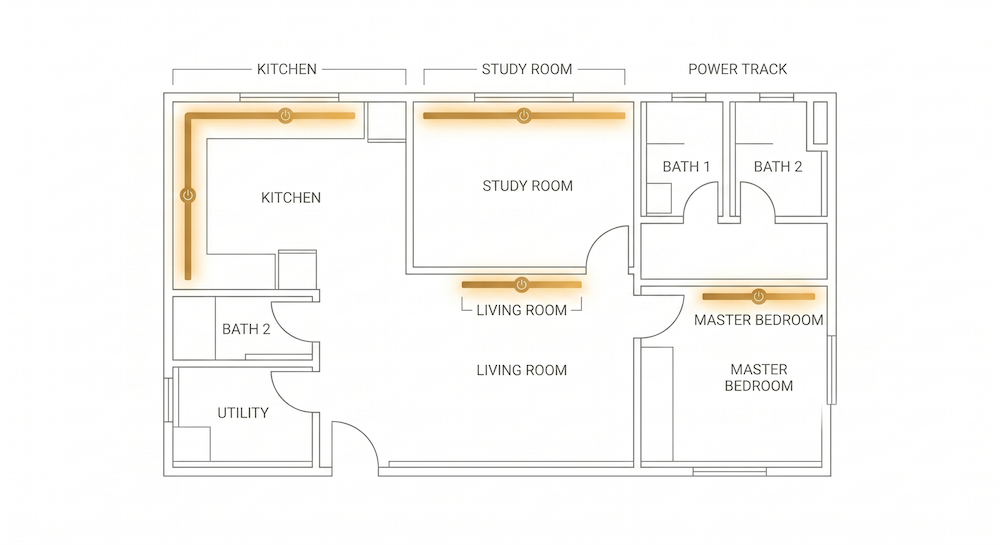
Floor plan showing power track installation zones in kitchen, study, living room, and master bedroom.

Power tracks perform best where multiple low-to-medium draw devices are used, appliance positions change over time, or trailing cables are a daily inconvenience
Kitchen countertop: The best zone for a wall power track

The kitchen countertop is the most common wall power track zone in Malaysian homes. Rice cooker, kettle, toaster, blender, and coffee machine positions change frequently. Fixed sockets planned at renovation stage are often wrong within a year.

  • Install position: Under the overhead cabinet, facing the countertop. Sockets remain accessible without occupying wall space above the splashback.
  • What not to connect: Hood, built-in oven, and hob require dedicated circuits on their own wiring runs. Do not connect these to the power track.

Confirm the power track position relative to cabinet height and countertop depth before the overhead cabinet is installed. A track mounted too high or too deep behind the cabinet edge is difficult to use daily.

Read: Kitchen Remodelling: Things to Consider Before Renovating Your Kitchen.

Study room and home office: Why power tracks work here

Study desks involve multiple devices in a confined area: laptop, monitor, desk lamp, phone charger, printer. Device count and layout change frequently. A fixed double socket is almost always in the wrong position.

  • Install position: Along the back wall at desk height, or under a floating desk shelf.
  • Cable management: Power track removes the need for extension cords running across the desk or floor.

For study room and home office design ideas, read: Study Room Design Ideas for Small & Large Spaces, and Home Office Designs for Small & Large Spaces.

Living room and TV console: Power track for multiple devices

TV consoles accumulate devices quickly: TV, streaming device, soundbar, gaming console, smart home hub. Fixed sockets become inaccessible within months.

  • Install position: Inside the TV console cabinet behind a cut-out, or along the back wall at console height.
  • Ventilation: Do not run power tracks behind enclosed sections with no ventilation. Heat must dissipate.

Bedroom: When a power track makes sense

  • Bedside zone: A short power track at bedside height replaces multiple sockets for phone charger, lamp, and tablet.
  • Study nook: Apply the same approach as the study zone where a desk is built into the bedroom.

Are power tracks worth the upgrade?

Yes, for the right zones and the right use case.

  • Worth it: Kitchen countertop where appliance positions change frequently.
  • Worth it: Study or home office desk where multiple devices are in daily use.
  • Worth it: Any zone where device count will grow and rewiring after renovation is impractical.
  • Not worth it: Zones already well-served by correctly positioned wall sockets.
  • Plan by zone: Identify which rooms have changing power needs and which have fixed appliance positions. Discuss both with your electrician at the renovation planning stage.

What to confirm before installing a power track in Malaysia

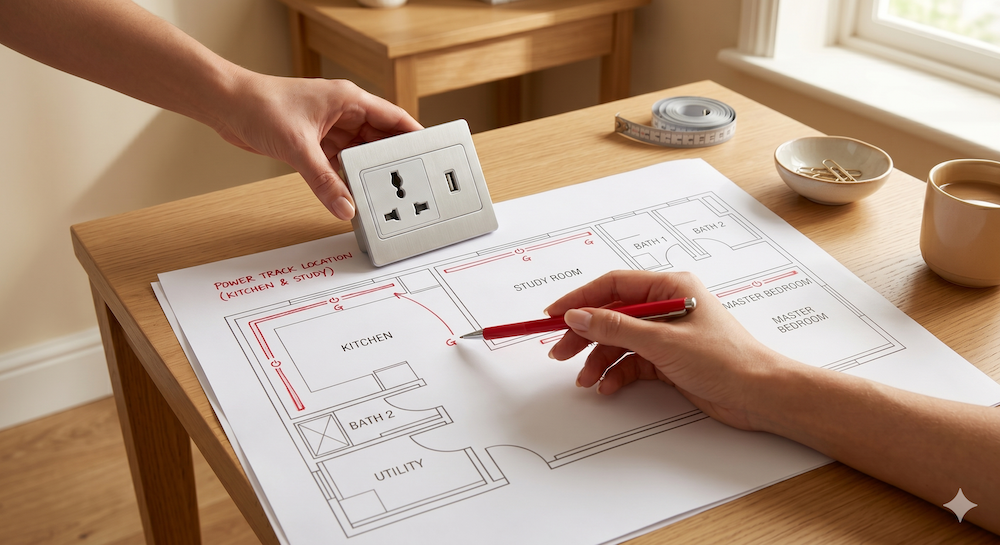
Power track adapter and floor plan being reviewed before installation.
  • Licensed electrician: All fixed electrical installations in Malaysia must be carried out by a licensed wireman or chargeman registered with Energy Commission Malaysia (Suruhanjaya Tenaga). Ask to see the licence before work begins.
  • Load capacity: Calculate the total wattage of all devices to be connected. Confirm the upstream circuit breaker rating supports this load before ordering the track.
  • Position confirmation: The track position must be agreed before cabinet installation, tiling, and wall finishing. Changing position after requires hacking.
  • Brand availability: Confirm adapters are locally stocked before committing to a brand. Imported-only systems create replacement gaps.
  • Water clearance: Minimum 300mm from any sink, tap, or splashback zone. Not suitable for outdoor or semi-outdoor kitchen installations.
  • Full electrical plan: Discuss power track installation alongside socket placement, lighting circuit, and appliance wiring. Power tracks planned in isolation produce conflicts with the overall electrical plan.

Conclusion

Power tracks suit zones where appliance positions change and multiple low-to-medium draw devices are in use. Standard wall sockets remain correct for fixed positions and high-draw appliances on dedicated circuits.

Identify which zones benefit from flexibility before works begin. Confirm the full electrical plan with a licensed electrician before cabinets and wall finishes are completed.

Signature Malaysia integrates power planning into full kitchen and study room renovation specifications. Speak to the team before finalising your renovation layout, or explore Signature’s kitchen range to see kitchen layouts and cabinet options.

For kitchen design ideas, read: Kitchen Design Ideas for Modern Malaysian Homes.

Our Flagship Store is relocating. Temporarily closed in August 2026, reopening September 2026 at