
 Sintered stone countertop withstanding direct heat from a boiling pot.
Sintered stone is a compressed natural mineral material fired at 1,200°C, producing a dense, non-porous slab with no resin or binding agents.
- What it is: Natural minerals compressed and fired at extreme heat. No polymer resin, no binders. The slab is homogeneous from surface to core.
- Why it suits outdoor and wet kitchen zones: UV-stable with no resin to degrade under sunlight. Heat-resistant up to 300°C. Non-porous, so kunyit, curry oil, and kopi leave no permanent stain.
- Where it is used: Sintered stone kitchen countertop installations include wet kitchen surfaces, outdoor kitchen islands, UV-exposed zones, and wall panels.
 Quartz countertop in Malaysian kitchen showing consistent white finish.
Quartz is an engineered stone made from 90 to 95 percent crushed natural quartz bound with polymer resin and pigment, producing a non-porous, consistent surface.
- What it is: Natural quartz mineral content bound with polymer resin under heat and pressure. The quartz is natural; the resin binder is engineered.
- Why it is popular in Malaysia: The quartz kitchen countertop is non-porous and hygienic, resisting bacterial growth, with no sealing required, available in a wide colour range, with consistent appearance across slabs, and widely available across Malaysian showrooms.
- Its key limitation: Polymer resin yellows permanently under UV and discolours above 150°C. Where a wet kitchen is open to sunlight or sees direct wok heat, sintered stone is the better choice. In a covered wet kitchen used with trivets, quartz still holds up well.
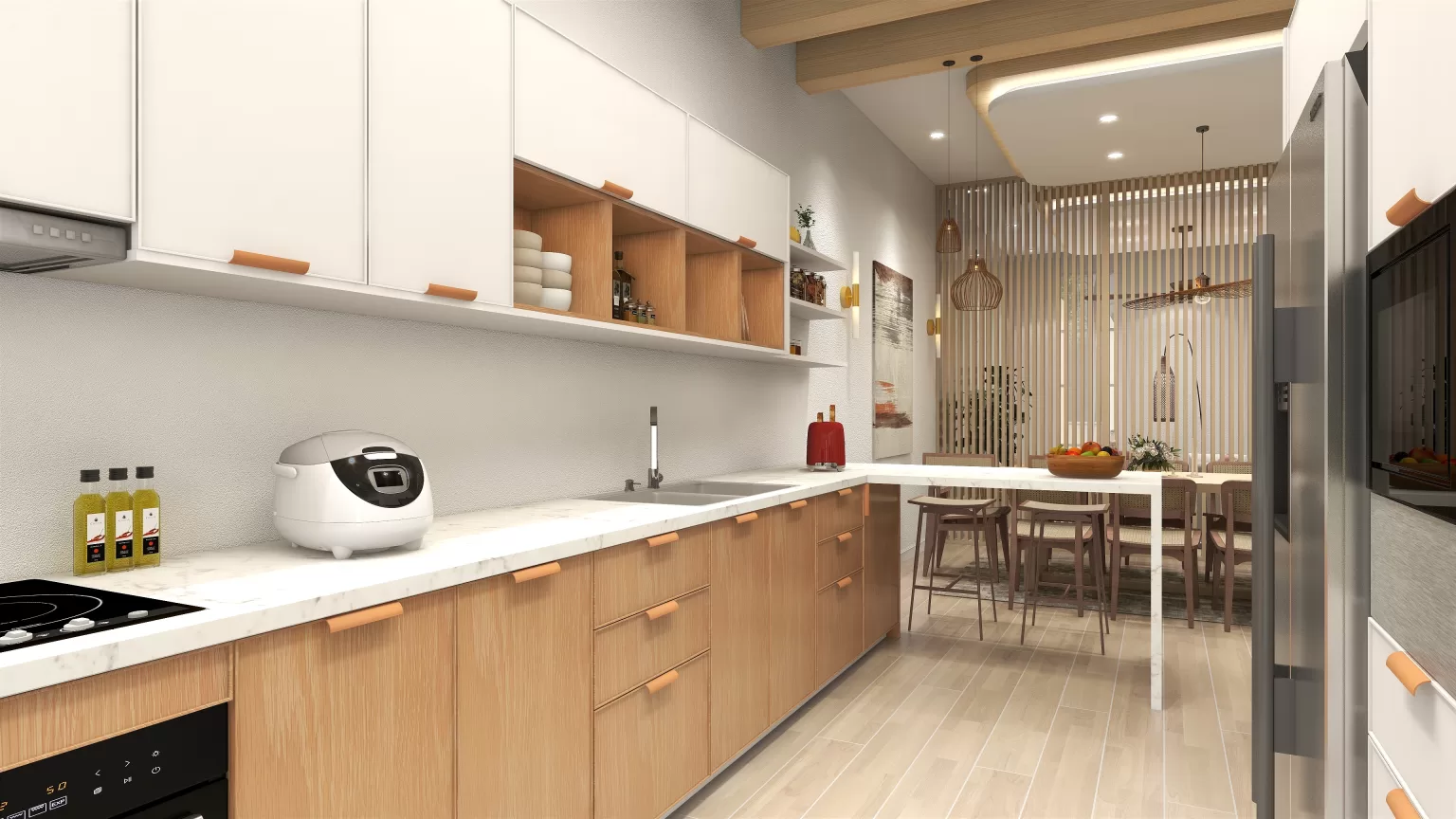 Wet kitchen with induction hob, sink, and quartz countertop.
Sintered stone is the strongest choice for wet kitchen countertops and any outdoor kitchen zone, especially where direct wok heat or UV exposure is involved.
- Where quartz is limited: UV causes permanent resin yellowing in open or outdoor zones, and direct wok heat above 150°C can discolour the surface. In a covered wet kitchen used with trivets, quartz performs well, but sintered stone handles direct heat and UV without that risk.
- Why sintered stone suits: UV-stable with no resin to degrade under sunlight. Heat-resistant up to 300°C. The most suitable engineered countertop material for outdoor Malaysian kitchens.
Specify a 3mm chamfer, a small angled cut at the edge, on all sintered stone panels at fabrication. Sintered stone is brittle at cut edges and chips more easily than quartz without this treatment.
For wet kitchen layout and design ideas, read: 7 Wet Kitchen Design Ideas for a Stylish & Functional Home.
 Quartz is the correct choice for dry kitchen countertops in Malaysian homes.
- UV is not a factor indoors: The resin limitation that applies in open or high-heat wet zones does not apply inside an enclosed dry kitchen.
- Polymer resin adds impact tolerance: Items dropped on corners and edges are less likely to chip than on sintered stone.
- Wider colour range and consistent appearance: What you see in the showroom arrives on site across every slab.
For Malaysian dry kitchens, Signature Quartz Neutral series, including Cotton, Santorini, and Paloma White, suits contemporary cabinet finishes with consistent, neutral tones.
Always use trivets on quartz. Resin discolours permanently above 150°C, non-negotiable, not a precaution.
For dry kitchen design ideas, read: 12 Dry Kitchen Design Concepts for a Modern and Stylish Home.
 Malaysian kitchen showing coordinated countertop tones across cooking zones.
For terrace houses, semi-Ds, and bungalows with separate wet and dry kitchens, the countertop decision is not a single choice.
- Design challenge: When both kitchens share a sightline from the living or dining area, the countertop tones need to read as one considered decision, not two separate choices made at different times.
- Coordination principle: Select the quartz colour first, then match the sintered stone tone to it. Quartz has the wider colour range, making it easier to find a sintered stone that complements rather than the reverse.
Plan both countertop selections together at the design stage, not separately.

