Baba Nyonya Design Inspiration & Ideas For Your Home
Key takeaways
Baba Nyonya design blends Chinese, Malay, and colonial influences into one of Malaysia’s most distinctive heritage styles, rooted in Penang and Melaka.
The style is defined by jewel-tone colours, intricate floral motifs, Peranakan tiles, and ornate carved furniture.
Peranakan interior design adapts to modern Malaysian homes when applied selectively, without losing its cultural character.
The Peranakan colour palette is built on bold jewel tones contrasted against a white or cream base, with brass and gold accents.
One strong Peranakan element per room is enough. Over-decorating is the most common mistake in Baba Nyonya design.
Introduction: What is Baba Nyonya?
Baba Nyonya design, also known as Peranakan design, traces its roots to the descendants of Chinese immigrants who settled in the Straits Settlements of Penang and Melaka. Over generations, they adopted local Malay customs while retaining Chinese traditions, producing one of Malaysia’s most distinctive cultural and design identities.
What makes Baba Nyonya unique is its hybrid character. No other culture in Malaysia blends Chinese, Malay, and British colonial influences into a single, cohesive design language. The result is an interior style that is vibrant, layered, and deeply rooted in Malaysian cultural history.
This style is not limited to heritage shophouses. It adapts to modern Malaysian condos, terrace houses, and landed properties. This guide covers what defines the style, how to use Peranakan tiles and furniture, room-by-room design ideas, and the most common mistakes to avoid.
What is Baba Nyonya interior design?
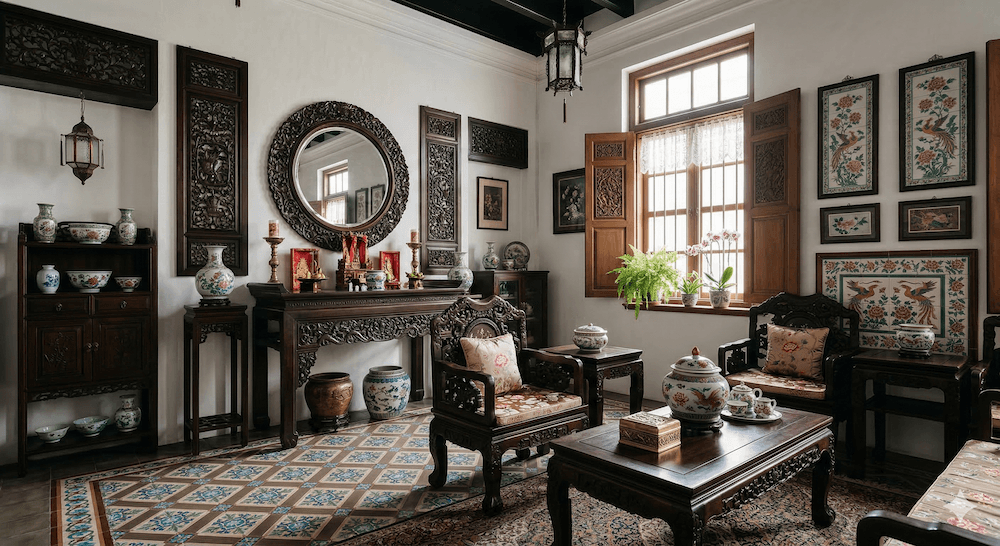
Baba Nyonya interior with Peranakan tiles and carved wood furniture.
Baba Nyonya interior design is characterised by vibrant colours, intricate patterns, ornate carved furniture, and handcrafted Peranakan tiles. Every element reflects a specific cultural identity.
Unlike purely Chinese or Malay design, Peranakan interior design is a hybrid. It is expressive, nuanced, and rich in cultural meaning, drawing from floral motifs, bold colour contrasts, and handcrafted materials that evolved over centuries in Penang and Melaka.
It is not a museum style. Applied selectively, Baba Nyonya elements bring warmth, personality, and cultural depth to modern Malaysian homes without overwhelming the space.
What makes Baba Nyonya design distinctive?
Baba Nyonya design is defined by five core elements found consistently across Peranakan shophouses and modern interpretations.
Vibrant jewel-tone colours: Emerald, cobalt, coral, gold, and magenta, always contrasted against white or cream.
Intricate floral and bird motifs: Appearing on tiles, textiles, furniture, and walls.
Peranakan tiles: Hand-painted and patterned, used on floors and feature walls.
Peranakan furniture: Dark carved wood with mother-of-pearl inlay, ornate joinery, built to display craftsmanship.
Layered decorative detail: Every surface is intentional, with each element carrying cultural meaning.
What is the Peranakan colour palette?
The Peranakan colour palette is built on bold jewel tones contrasted against white or cream, with gold and brass accents throughout. It is never monochrome.
Base: White, cream, or soft yellow for walls and large surfaces.
Jewel tones: Emerald green, cobalt blue, coral red, and magenta for tiles, furniture, and accents.
Gold and brass: Fixtures, frames, and hardware.
Contrast: Bold colour always sits against a white base. Without the white, the palette clashes.
In modern Malaysian homes, use white as the dominant base and introduce Peranakan colours through tiles, cushions, and accent furniture. This avoids overwhelming smaller condos and compact spaces.
What are Peranakan tiles?
Peranakan tiles are hand-painted encaustic cement tiles featuring intricate floral, geometric, and nature-inspired patterns in bold colours. They are a signature element of Peranakan shophouses in Penang and Melaka, and one of the easiest ways to introduce the style into a modern home.
Peranakan tiles work across several surfaces in a modern Malaysian home.
Floor feature: Entrance, kitchen, or bathroom floor as a statement surface.
Feature wall: Living room backdrop, dining feature wall, or bathroom accent wall.
Kitchen backsplash: Small area of pattern with high visual impact.
Staircase risers: A traditional application that still works beautifully in modern landed homes.
They are widely available across Malaysia today, so you can achieve the authentic look at a fraction of the cost of original antique pieces.
What are some Baba Nyonya interior design ideas?
Baba Nyonya design can be applied across every room. The key is balancing rich detail with breathing space.
Baba Nyonya living room
Baba Nyonya living room with Peranakan tile feature wall and modern furniture.
Feature wall: Peranakan tile panel or floral wallpaper as the room’s focal point.
Furniture: Dark carved wood sofa set with embroidered cushions, or rattan seating with bold fabric.
Colours: White walls with emerald, cobalt, or coral accents.
Lighting: Brass pendant lights or ornate lantern-style fixtures.
Decor: Ceramic vases, porcelain pieces, and embroidered textiles.
Peranakan kitchen design
Peranakan kitchen with tile backsplash, white cabinets, and brass accents.
Cabinetry: White or cream with brass hardware, or dark wood with a coloured tile backsplash.
Backsplash: A Peranakan tile pattern delivers the highest visual impact at the lowest cost.
Countertops: White marble or marble-effect to keep the base light.
Fixtures: Brass or gold taps and handles.
Open shelving: Display Nyonya porcelain and ceramics to reinforce the heritage character.
Baba Nyonya bedroom
Baba Nyonya bedroom with carved bed and batik textiles.
Bed frames: Dark carved wood or rattan with an ornate headboard.
Textiles: Embroidered bedding, batik-print cushions, and sarong-fabric throws.
Feature wall: Floral wallpaper or a Peranakan tile panel behind the headboard.
Colours: White base with one jewel-tone accent, either emerald, cobalt, or coral.
Lighting: Brass bedside lamps or an ornate pendant.
Peranakan bathroom design
Peranakan bathroom with patterned floor tiles, brass fixtures, and white walls.
Tiles: Peranakan floor tiles paired with white wall tiles. Let the floor be the feature.
Fixtures: Brass or gold taps and shower fittings.
Vanity: White with brass hardware, or dark wood.
Accessories: Ceramic soap dishes, embroidered hand towels, and porcelain accessories.
What is modern Peranakan interior design?
Modern Peranakan interior design looks different depending on your property type. It is not a full replica of a traditional shophouse but a selective application of key elements suited to your space.
Condo: One Peranakan tile backsplash or feature wall, white base throughout, one brass or carved wood accent piece.
Terrace house: Peranakan tile entrance floor, carved wood feature in the living room, jewel-tone kitchen backsplash.
Landed home: A full Peranakan room is possible, with tile floors, carved furniture, and layered textiles, without overwhelming the space.
What are common mistakes in Baba Nyonya interior design?
Over-decorating: Every surface competing creates visual chaos. Let one element lead per room.
Wrong colour combinations: Peranakan colours work because of contrast against white. Remove the white base and the palette clashes.
Misusing tiles: Peranakan tiles on every surface overwhelm the space. Use them on a feature floor, as a backsplash, or on one wall only.
Ignoring scale: Ornate furniture in a small condo overpowers. Choose one statement piece and keep the rest simple.
Copying without context: Mixing patterns from unrelated cultures does not produce Peranakan design. Stick to the Straits Chinese visual vocabulary, floral encaustic tiles, dark carved wood, and jewel tones against white.
Conclusion
Baba Nyonya design is one of Malaysia’s most distinctive heritage styles, rooted in Penang and Melaka, built on colour, pattern, and craftsmanship.
Start with one element. A Peranakan tile backsplash, a carved cabinet, or a jewel-tone accent wall. Build from there.
Signature Malaysia can help bring Baba Nyonya-inspired design into your home. Explore Signature’s portfolio for real-world inspiration, or speak to our team to get started.