Signature Malaysia

Sintered Stone vs Quartz: Which Is Better for Kitchen Countertops?

Key takeaways
  • The choice between sintered stone and quartz in a Malaysian kitchen is not about quality. It is about which zone each material is suited to.
  • Sintered stone is UV-stable and heat-resistant up to 300°C, making it the most suitable engineered countertop material for outdoor zones and wet kitchens with direct wok heat.
  • Quartz contains polymer resin that yellows under UV and discolours above 150°C, so it suits dry kitchens and covered indoor wet kitchens used with trivets, while UV-exposed and direct-heat zones call for sintered stone.
  • For Malaysian homes with both zones, sintered stone is the strongest choice for the wet kitchen, with quartz ideal for the dry kitchen, coordinating colours at the design stage.
  • Signature Malaysia offers sintered stone countertops and Signature Quartz across multiple series, in polish, matte, and texture finishes, with a 10-year limited warranty.

Introduction

Sintered stone and quartz are the two most-compared countertop materials in Malaysian kitchens today. Both are premium and engineered, but under Malaysian conditions, they behave very differently, and choosing the wrong material for the wrong zone produces damage that no maintenance will reverse.

High-heat wok cooking, UV-exposed wet kitchen and outdoor zones, tropical humidity, and daily cooking with kunyit and curry all test countertop materials in ways a showroom visit never will. Sintered stone in Malaysia is most commonly specified for wet kitchen countertops and outdoor kitchen islands, zones where direct UV and sustained wok heat push quartz resin beyond its limits. A countertop that performs well in a European kitchen may yellow, stain, or crack within months under Malaysian conditions. 

This article covers what each material is, how both materials compare on heat resistance, UV stability, and stain resistance, which zone suits which material, and what to watch out for before specifying.

For a full comparison of marble and quartz, read: Marble vs Quartz: Which Is Better for Kitchen Countertops in Malaysian Homes?

What is sintered stone?

Sintered stone countertop withstanding direct heat from a boiling pot.Sintered stone countertop withstanding direct heat from a boiling pot.

Sintered stone is a compressed natural mineral material fired at 1,200°C, producing a dense, non-porous slab with no resin or binding agents.

  • What it is: Natural minerals compressed and fired at extreme heat. No polymer resin, no binders. The slab is homogeneous from surface to core.
  • Why it suits outdoor and wet kitchen zones: UV-stable with no resin to degrade under sunlight. Heat-resistant up to 300°C. Non-porous, so kunyit, curry oil, and kopi leave no permanent stain.
  • Where it is used: Sintered stone kitchen countertop installations include wet kitchen surfaces, outdoor kitchen islands, UV-exposed zones, and wall panels.

What is quartz?

Quartz countertop in Malaysian kitchen showing consistent white finish.Quartz countertop in Malaysian kitchen showing consistent white finish.

Quartz is an engineered stone made from 90 to 95 percent crushed natural quartz bound with polymer resin and pigment, producing a non-porous, consistent surface.
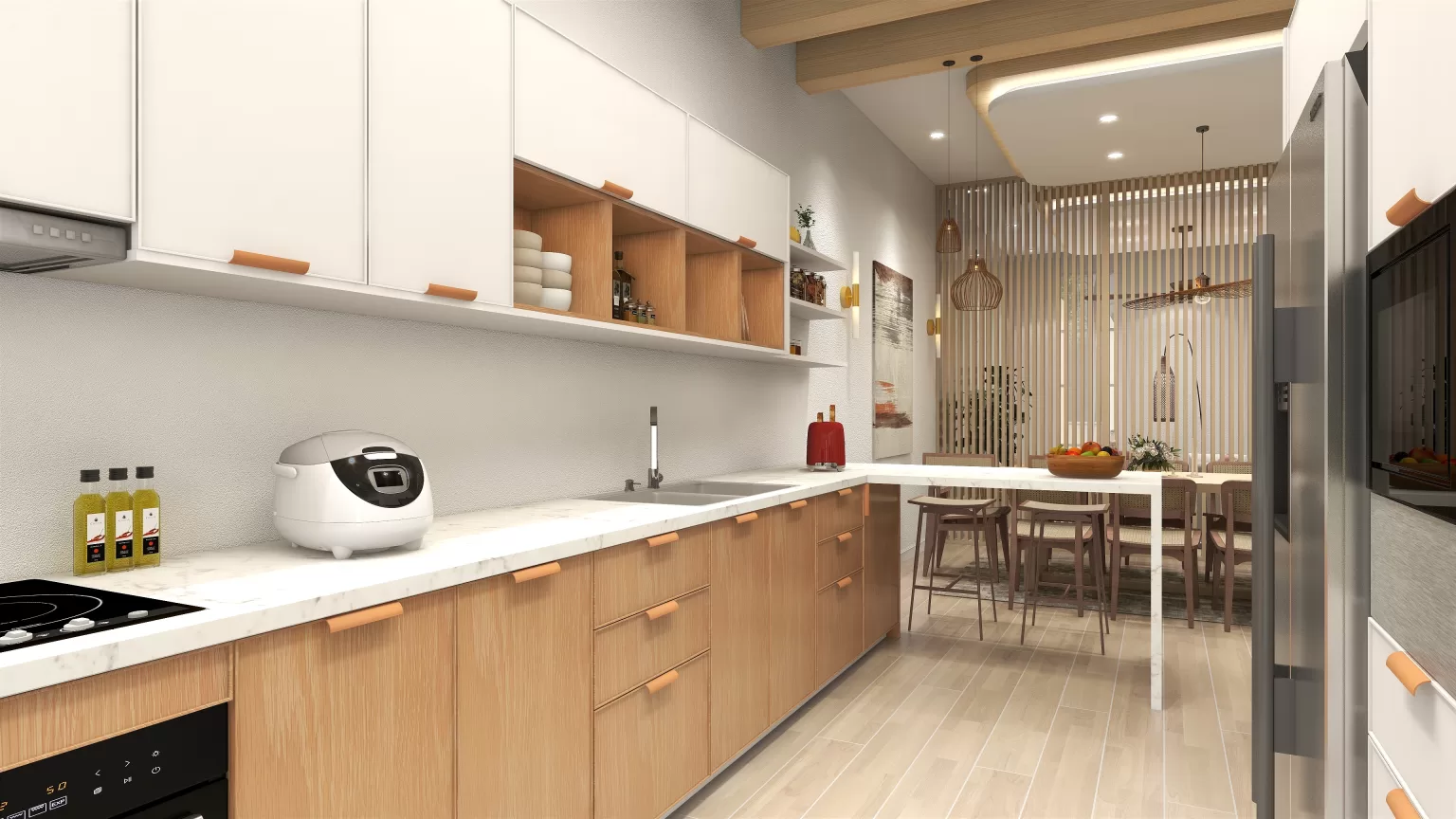
  • What it is: Natural quartz mineral content bound with polymer resin under heat and pressure. The quartz is natural; the resin binder is engineered.
  • Why it is popular in Malaysia: The quartz kitchen countertop is non-porous and hygienic, resisting bacterial growth, with no sealing required, available in a wide colour range, with consistent appearance across slabs, and widely available across Malaysian showrooms.
  • Its key limitation: Polymer resin yellows permanently under UV and discolours above 150°C. Where a wet kitchen is open to sunlight or sees direct wok heat, sintered stone is the better choice. In a covered wet kitchen used with trivets, quartz still holds up well.

How do sintered stone and quartz compare?

As sintered stone and quartz countertop options, both are non-porous and require no sealing. The differences that matter only become visible under Malaysian conditions: UV exposure, wok heat, and sustained humidity over time.

Factor

Sintered Stone

Quartz

Heat resistance

Up to 300°C, handles hot cookware

Above 150°C damages resin. Trivets required at all times.

UV resistance

Colour-stable in direct sunlight

Resin yellows under UV. Not for UV-exposed or outdoor zones.

Scratch resistance

Mohs 6–8, suits daily kitchen use

Mohs 6–7, suits daily kitchen use

Stain resistance

Non-porous, no sealing. Kunyit, curry, and kopi wipe off cleanly. 

Non-porous, no sealing. Kunyit, curry, and kopi wipe off cleanly. 

Impact resistance

Hard but brittle at cut edges. Chips more easily without a 3mm edge chamfer.

Resin adds flex, more forgiving on edges

Design range

Dramatic natural stone looks, large-format slabs

Wider colour range, consistent appearance across slabs

Neither material is universally better. The right choice follows the kitchen zone.

Which countertop is right for a Malaysian kitchen?

The sintered stone and quartz countertop decision follows the kitchen zone. Malaysia’s wet and dry kitchen separation makes the choice straightforward once zones are mapped correctly.

Wet kitchen and outdoor zones

Wet kitchen with induction hob, sink, and quartz countertop.Wet kitchen with induction hob, sink, and quartz countertop.

Sintered stone is the strongest choice for wet kitchen countertops and any outdoor kitchen zone, especially where direct wok heat or UV exposure is involved.

  • Where quartz is limited: UV causes permanent resin yellowing in open or outdoor zones, and direct wok heat above 150°C can discolour the surface. In a covered wet kitchen used with trivets, quartz performs well, but sintered stone handles direct heat and UV without that risk.
  • Why sintered stone suits: UV-stable with no resin to degrade under sunlight. Heat-resistant up to 300°C. The most suitable engineered countertop material for outdoor Malaysian kitchens.

Specify a 3mm chamfer, a small angled cut at the edge, on all sintered stone panels at fabrication. Sintered stone is brittle at cut edges and chips more easily than quartz without this treatment.

For wet kitchen layout and design ideas, read: 7 Wet Kitchen Design Ideas for a Stylish & Functional Home.

Dry kitchen and indoor use

Quartz countertop in dry kitchen showing colour consistency across slabs.
Quartz is the correct choice for dry kitchen countertops in Malaysian homes.

  • UV is not a factor indoors: The resin limitation that applies in open or high-heat wet zones does not apply inside an enclosed dry kitchen.
  • Polymer resin adds impact tolerance: Items dropped on corners and edges are less likely to chip than on sintered stone.
  • Wider colour range and consistent appearance: What you see in the showroom arrives on site across every slab.

For Malaysian dry kitchens, Signature Quartz Neutral series, including Cotton, Santorini, and Paloma White, suits contemporary cabinet finishes with consistent, neutral tones.

Always use trivets on quartz. Resin discolours permanently above 150°C, non-negotiable, not a precaution.

For dry kitchen design ideas, read: 12 Dry Kitchen Design Concepts for a Modern and Stylish Home.

Homes with both a wet and dry kitchen

Malaysian kitchen showing coordinated countertop tones across cooking zones.Malaysian kitchen showing coordinated countertop tones across cooking zones.

For terrace houses, semi-Ds, and bungalows with separate wet and dry kitchens, the countertop decision is not a single choice.

  • Design challenge: When both kitchens share a sightline from the living or dining area, the countertop tones need to read as one considered decision, not two separate choices made at different times.
  • Coordination principle: Select the quartz colour first, then match the sintered stone tone to it. Quartz has the wider colour range, making it easier to find a sintered stone that complements rather than the reverse.

Plan both countertop selections together at the design stage, not separately.

What should you watch out for when choosing a countertop material?

  • Assuming both materials perform equally indoors: Quartz outperforms sintered stone on impact tolerance and edge durability in dry kitchen zones. Sintered stone is harder but more brittle at cut edges.
  • Placing hot woks directly on quartz: Resin damage above 150°C is permanent and cannot be repaired.
  • No edge chamfer on sintered stone: Chips more easily at cut edges without a 3mm chamfer. Confirm at fabrication, not after installation.
  • Choosing by showroom appearance alone: Sintered stone and quartz can look similar as samples. Real performance differences only show under Malaysian conditions.
  • Treating the countertop as a separate decision from cabinet design: Material thickness, edge profile, and colour all affect how cabinet doors and handles read visually.

For how countertop and cabinet materials work together, read: Which Kitchen Cabinet Material Is Best in Malaysia? Melamine, Blockboard, Plywood & More Compared.

For more countertop guidance, read: How to Choose Kitchen Countertops.

What to confirm before specifying sintered stone or quartz

  • Sintered stone: Specialist diamond-tipped tooling is required for cutting and fabrication. Confirm your supplier is equipped before ordering.
  • Quartz: Confirm slab consistency across batches before ordering multiple slabs.
  • Specify both countertops at the design stage as part of the full kitchen package. Material thickness, edge profile, and installation sequencing must be coordinated together.

Signature Malaysia offers sintered stone and Signature Quartz across multiple series, in polish, matte, and texture finishes, with a 10-year limited warranty.

Conclusion

Choosing between sintered stone and quartz in a Malaysian home is a zone-based decision, and the zones are clear. Sintered stone suits outdoor and wet kitchen zones where UV and wok heat are unavoidable. Quartz suits indoor dry kitchens and covered wet kitchens used with trivets, where UV is not a factor, and its wider colour range and impact tolerance take over. For homes with both zones, use both and choose them together at the design stage alongside the cabinet specification.

Signature Malaysia integrates countertop selection, including sintered stone and Signature Quartz, into the full kitchen design process. Speak to the team before finalising your kitchen layout, or explore Signature’s kitchen range for design ideas and material guidance.

Our Flagship Store is relocating. Temporarily closed in August 2026, reopening September 2026 at